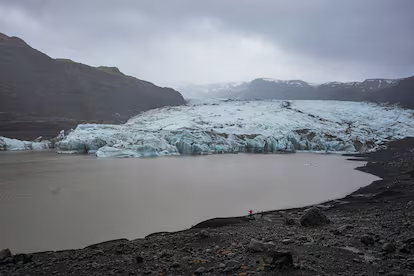
Srinagar, Jun 27: A new report by the World Meteorological Organization (WMO) has revealed a stark decline in glacier thickness across the globe over the past seven decades, attributing the loss to accelerating climate change.
The report, accessed by wire news agency — KNO, cites data from the World Glacier Monitoring Service (WGMS), showing that glaciers worldwide have lost an average of 32.5 meters water equivalent (MWE) in thickness since 1950. The glacier balance shifted dramatically from +5.392 MWE in 1950 to -27.123 MWE in 2024.
WGMS further noted that the period from 2022 to 2024 marks the worst three-year glacier mass balance on record, with the value dropping from -24.794 to -27.123 MWE during that span. This decline is a strong indicator of the accelerated melting occurring worldwide.
Experts attribute this alarming trend to global warming, which increases glacier melt while reducing snowfall that replenishes them. A major consequence of this melting, they warn, will be future water scarcity.
In the context of Jammu and Kashmir, prior studies have highlighted similar concerns. Experts warn that the region has already lost about 30% of its glaciers over the last 60 years, and that up to 70% could disappear by the end of the century if current warming trends continue.
Earlier this year, Prof. Shakil Ahmad Romshoo, Vice-Chancellor of IUST and Head of the National Cryosphere Lab at the University of Kashmir, emphasized the urgency of addressing glacier loss during a research event on the Himalayan cryosphere. He highlighted a significant decline in streamflow since the 1990s, posing risks to water supply, energy, and food security in South Asia.
According to Prof. Romshoo, addressing glacier melt is not just a scientific challenge but a critical policy concern, calling for collaborative efforts from researchers, governments, and stakeholders.
Experts also noted that carbon neutrality is the only effective solution to slow down glacier loss. “Jammu, Kashmir, and Ladakh have over 18,000 glaciers—and they are all melting,” they stated. High winter temperatures in February and March have accelerated the melting of both snowfall and glacial ice.
The WMO confirmed that 2024 has been the warmest year ever recorded, based on six global datasets. Each of the past ten years ranks among the warmest, marking an unprecedented streak of rising global temperatures.
Experts estimate that J&K is losing 18–20 meters of glacier every year. They caution that if carbon emissions continue to rise, no intervention short of becoming carbon neutral can stop the rapid glacial retreat.
With Inputs from the KNO